Quick Summary — Why "It Is Just Nearby" Costs More Than A Towing Service
"It is just nearby." That single sentence is what turns one vehicle-moving job into two workshop jobs. Workshop three kilometres away, house five kilometres away — it does not feel worth paying anyone for a distance that short.
The problem was never the distance. A car being pulled with the engine dead behaves nothing like the car you drive every day. The moment the engine stops, three systems you take for granted disappear together — and they disappear instantly, not gradually.
- The brakes lose vacuum assistance. The pedal turns rock hard after the first press or two.
- The steering loses power assistance. Dodging a pothole or a motorcycle cutting in front takes both arms and your shoulders, not your fingertips.
- The brake lights and indicators may not come on at all if the key is not turned to the accessory position. The car behind you has no idea what you are about to do.
- The steering lock can engage on its own. The front wheels stop pointing where you want them and the car goes wherever it feels like going.
- A rope has no brakes. When the front car slows, the rear car keeps rolling until the rope goes slack — and when it snaps tight again, that whole shock load lands on one small point of the bumper.
Comparison Table — A Rope Versus A Professional Towing Service
Compare the six things that actually matter. Not just price — price is one line out of six.
- Risk of damage to the vehicle — Rope: the bumper, subframe, radiator mounts and gearbox all turn into stress points, and the damage usually only shows itself after you arrive. · Professional towing: the vehicle is lifted or carried, with the load taken by the parts of the chassis built to carry it.
- Brakes and steering with the engine dead — Rope: both lose their assistance, and the person sitting in the broken car is the one who has to deal with it. · Professional towing: your car does not have to stop itself. The tow unit does that job.
- Liability if there is an accident — Rope: two vehicles joined together, two drivers, and fault gets messy fast. · Professional towing: the vehicle stays in the custody of the operator for the whole trip.
- Sensible distance — Rope: a few metres inside a closed compound, not an actual journey. · Professional towing: from the back lane of your house to across state lines, same procedure either way.
- Second driver needed — Rope: compulsory. Someone has to sit at the wheel of the dead car the whole way, with no proper brakes. · Professional towing: one person is enough — you.
- Effect on an insurance claim — Rope: damage caused by the pulling method itself can be disputed, and there is usually no "before" evidence to show. · Professional towing: the vehicle travels as cargo, with a record of the trip.
What Happens To A Car Pulled With The Engine Dead — Why Car Towing Exists
On most cars, brake assistance comes from vacuum the engine produces. Engine dead means the vacuum left in the reservoir is only good for one or two normal presses. After that the pedal turns hard, and the stopping distance stretches out at the worst possible moment — at a junction, as the light turns red.
Power steering is the same story. Hydraulic systems are driven off the engine belt; electric systems depend on a supply that may already be gone if the battery is what died in the first place. Either way the wheel goes heavy suddenly, not gradually.
The attachment point is where most people get it wrong. Most cars have one threaded tow eye hole behind a small cover on the bumper, and the screw-in eye lives with the jack. That is the only point the manufacturer approves. Tie onto an anti-roll bar or a suspension arm and you have swapped an engine problem for a wheel geometry problem.
Then there is the shock loading. A rope between two cars is never tight for long — it goes slack, tight, slack, tight, the whole way. Every time it snaps tight, the entire weight of the rear car arrives at one small point on the front bumper in an instant. That is why bumpers rip off. Not because the bumper is weak.
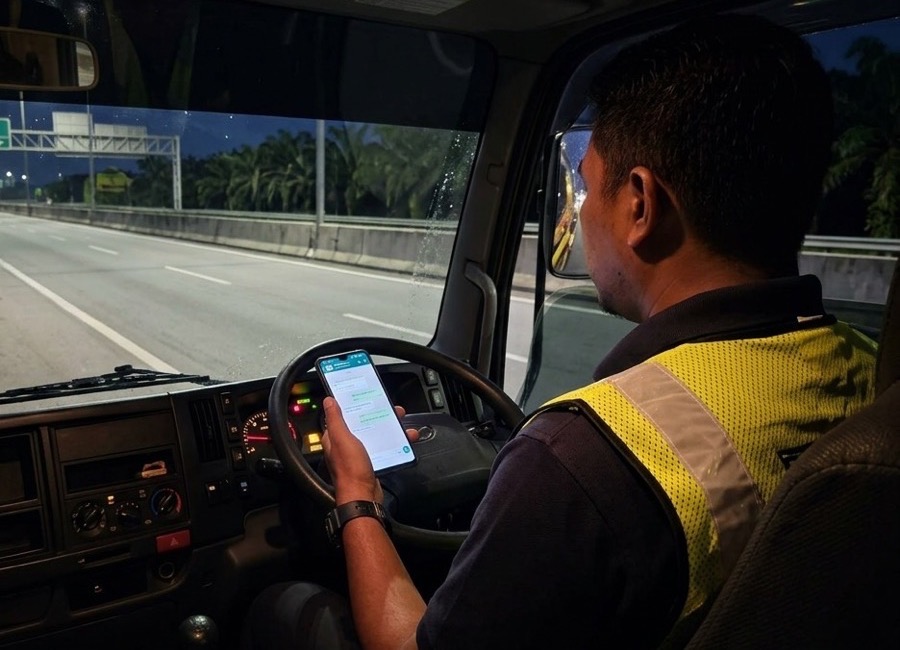
If you are already feeling uneasy reading this — that feeling is correct. WhatsApp your location, your vehicle type and what went wrong. The full price is confirmed in the chat before the unit moves, and you do not have to find anybody to sit at the wheel of a car with no brakes.
The Rare Case Where Moving It Yourself Still Works — Before You Call A 24 Hour Tow Truck
There is one scenario, and only one, where moving the vehicle yourself makes sense: inside a closed compound, a few metres only, without touching a public road at all. A car that has died in front of the gate, for example, or one that has to come out of a parking bay so the tow truck can get in.
Even then, the method is not a rope tied to another car. The method is pushing by hand, with enough people, and with one person at the wheel. Follow this order:
- Make sure the ground is genuinely flat. If there is even a slight slope, stop here — a car that starts rolling on its own cannot be stopped by hand.
- Turn the key to accessory or ON so the steering lock releases and the brake lights work. Do not pull the key out.
- Put the gear in neutral. A manual goes into N; an automatic needs full N, not just out of P.
- Put someone in the driver seat before the handbrake comes off — not after. That person does not leave the car until the job is done.
- Put a second person in front as a spotter — make sure nobody, especially no child, is in the path.
- Push from a solid part — the door pillar or the rear of the body. Do not push on the bumper or the grille.
- Stop before the wheels touch a public road. That is where your own work ends and where the tow unit takes over.
Automatics, AWD And EVs — Why Flatbed Towing Is The Only Safe Answer
An automatic is not merely "less suitable" for being pulled — it is the one that loses money fastest. On most automatic gearboxes the transmission fluid pump is driven by the engine. Engine dead, pump stopped, but the moment the car is pulled with the drive wheels turning, parts inside that gearbox keep spinning with no lubrication. This kind of damage is quiet. It shows up weeks later as a bill many times larger than the transport cost you were trying to save.
AWD and 4WD are stricter still: all four wheels are connected to one driveline. There is no safe "lift the front only" or "lift the rear only" combination. For these vehicles every wheel has to come up — that is flatbed towing work, not rope work.
EVs have their own list of problems. When the wheels turn, the electric motor can act as a generator and push current back into a system that may already be damaged or wet. Many EVs also lock the driveline electronically — a dead 12V battery means you cannot get it into neutral at all. Which is why almost every EV manual says the same thing: carry it, do not pull it.
If you are not sure which category your car falls into, we have a separate guide comparing automatic and manual cars and the right towing method for each. Read that first, before anyone pulls a rope out of the boot.
When The Towing Price Beats The Repair Bill — Car, Motorcycle And Lorry Towing
This is the part people rarely finish calculating. Doing it yourself looks free because the cost up front is zero — the real cost sits behind, and it never enters your head while you are making the decision at the roadside.
List what is actually at stake. A front bumper that has been ripped off is not just plastic — behind it sit the mounts, the parking sensors, and on newer cars the driver-assist radar that has to be recalibrated afterwards. An automatic gearbox that has been spinning without lubrication is an engine-out job, not an oil change.
Now put the transport price next to it, the one you know before anything moves: deliveries under 50 km from RM250, under 100 km from RM450, under 150 km from RM550. One figure, confirmed on WhatsApp before the unit rolls. Compare that against a single bumper bill, never mind a transmission bill.
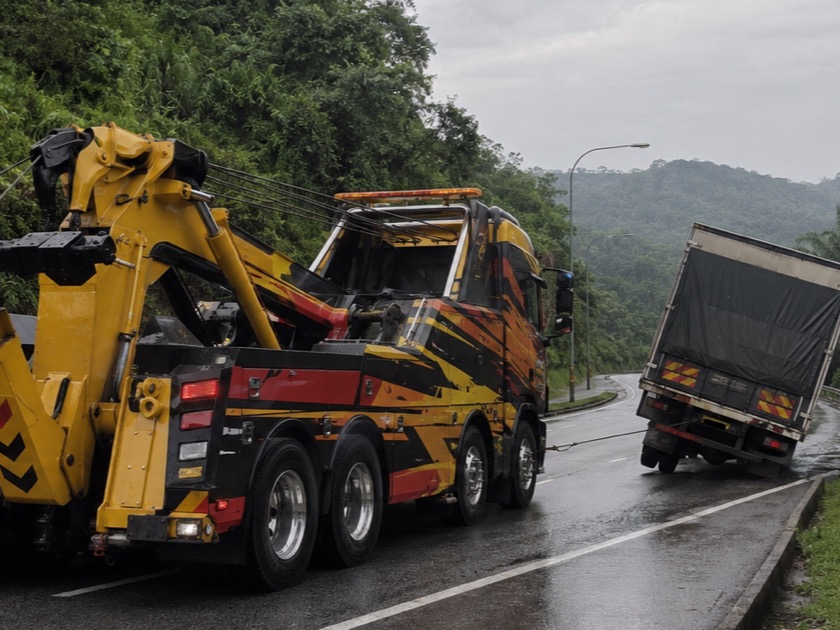
The same logic runs across the other vehicle types. Motorcycle towing costs a fraction of a scratched fairing and a bent fork on a bike that was walked or half-dragged home. Lorry towing is quoted by class — 5 ton, 10 ton and 15 ton — and no operator who has seen a commercial vehicle dragged on its own driveline would call it the cheap option.
There is one more cost that never appears on any receipt: the second person. Pulling with a rope needs two drivers and two vehicles — somebody has to leave whatever they were doing to sit at the wheel of a car with no brakes.
Short distance is no excuse either. In a small state like Perlis every destination feels close by — but the road you travel is still the same public road. A short distance does not remove a single one of the risks above. It only shortens how long you are exposed to them.
Verdict By Situation — Rope, Roadside Assistance Or Interstate Towing
There is no single answer, but there is a clear answer for every situation. Find yours.
- Car dead inside your compound or a car park, blocking the way, a few metres to move — push it by hand using the procedure above. No rope, no second car.
- Car dead at the side of a public road, even with the workshop in sight — get it towed. A public road means other traffic, and your car has no brakes you can rely on.
- Flat battery, flat tyre, or out of fuel and the car is otherwise fine — that is roadside assistance, not a tow. Say so when you message, and nobody wastes a trip.
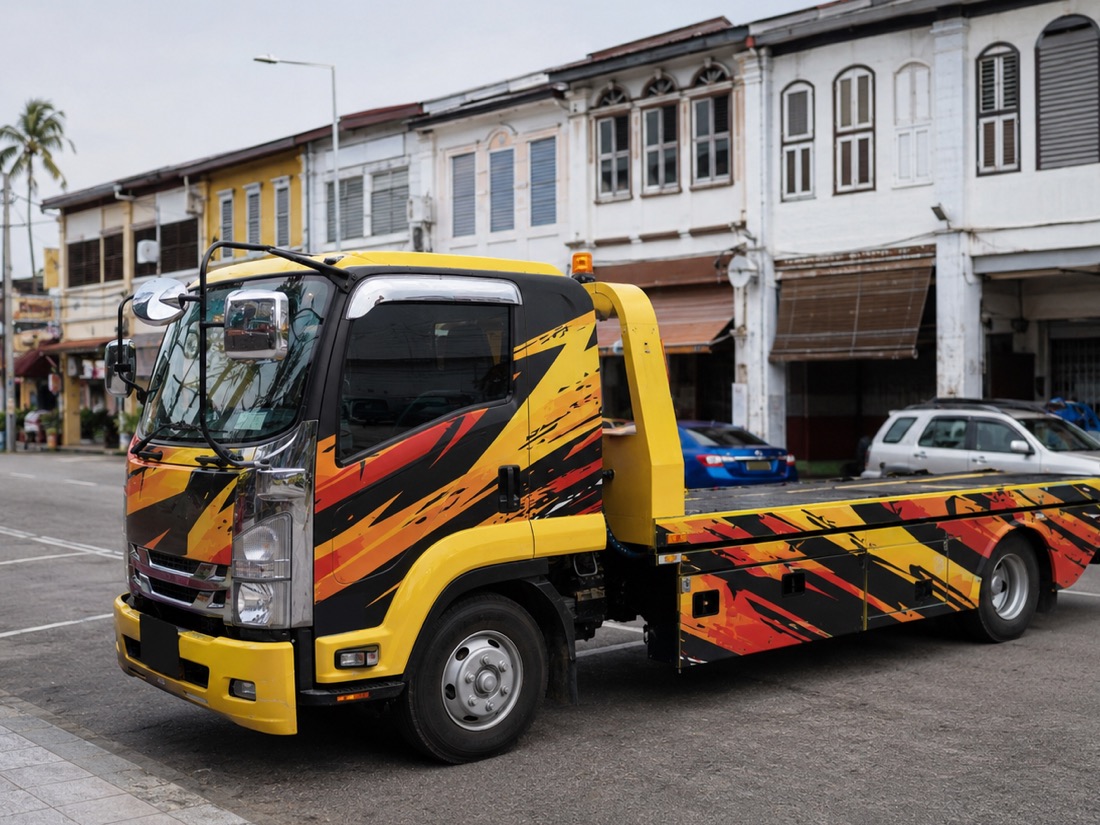
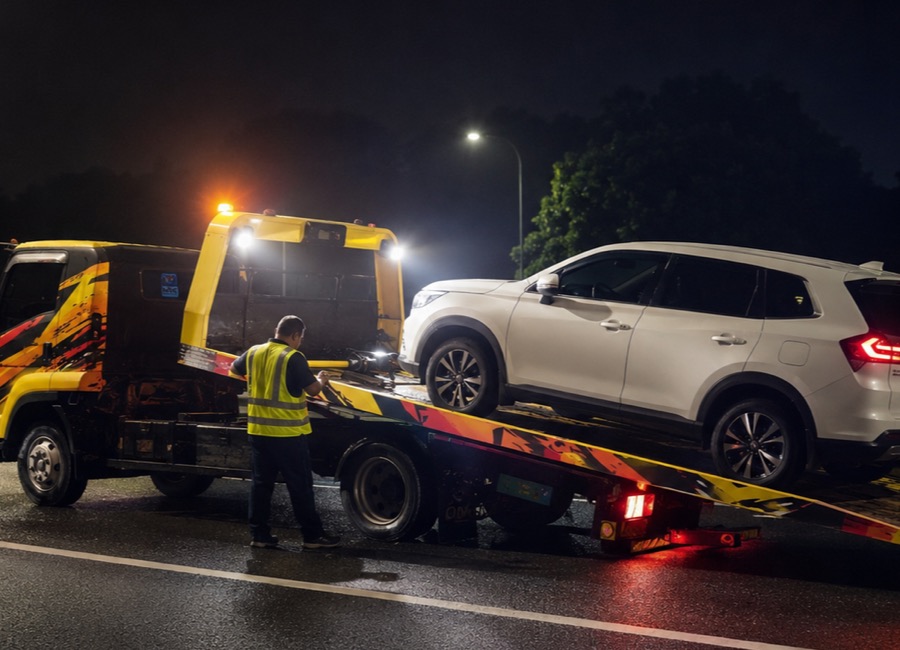
- Automatic, CVT, AWD or EV — carry it, do not pull it. Distance has nothing to do with it; the wheels have to come off the ground.
- An old car that has not started in a long time, hard tyres, seized brakes — do not force it to move on its own wheels.
- Car in an accident, flood-hit car, or a car leaking fluid — towing, no discussion. Hidden damage to the brakes and suspension cannot be judged by eye at the roadside.
- A trip between states, or a hill route like Karak, Genting or Cameron — interstate towing. Long descents punish the brakes of a healthy car, and a car on a rope has no brake assistance left to punish.
- You are unsure yourself — that is also an answer. Being unsure at the roadside means a risk that does not need weighing at all.
Conclusion — 24 Hour Towing Costs Less Than One New Bumper
A rope connects two cars. It does not connect the brakes, the lights or the responsibility — and that alone settles most of this decision.
If your vehicle is stranded right now, send your live location, the vehicle type and what happened in one message. The full price is confirmed in the chat before the unit moves — standby 24 hours, across Peninsular Malaysia. Save the number before you need it, not after.