Quick Verdict: When Insurance Towing Wins And When Booking Your Own Tow Truck Is Better
This question almost always arrives late — the car is already dead by the roadside and you have to decide right there on the shoulder. So here is the answer first, and the reasoning after.
The benefit inside your policy wins when your case is clean: private car, ordinary breakdown, short distance, and you do not mind the car going to the nearest panel workshop. In that situation the cost on the night is genuinely zero — you already paid for it through your premium, so not using it is money thrown away.
Booking an operator yourself wins the moment anything unusual shows up: long distance, a specific destination, a commercial vehicle, a water or drain case, or a policy quota that is already used up. In those cases the benefit either falls short, or does not apply at all.
The part nobody mentions: this is not really a one-or-the-other choice. Drivers who handle it well often use both — benefit up to the cap, own pocket for the remainder. The sixth section shows exactly how.
Quick summary before the detail:
- Use the policy benefit if: private car, comprehensive cover, distance within the cap, and the panel workshop genuinely works for you.
- Book your own if: you want a workshop of your choice, the trip is long or crosses state lines, the vehicle is commercial, it is a flood or off-road case, the quota is finished, or you are on a third party policy.
- Combine both if: your case qualifies but the distance goes past the cap — the benefit carries the first stretch, you carry the rest.
Insurance Towing vs Booking Your Own Towing Service — Six Deciding Factors
These six factors decide it. Read down the list and mark which one matters most for the situation you are in right now — not the hypothetical situation you pictured when you bought the policy.
One note before we start: every policy is different. The caps in your policy are not necessarily the caps your neighbour has, even if you both bought cover in the same year from the same place. What is listed here is the general pattern, not a promise. The real figures sit in your policy schedule.
- Cost — Insurance: nothing to pay at the scene as long as you stay inside the cap, because the cost already sits in your annual premium. Own booking: you pay per trip. Our distance tiers start from RM250 for delivery under 50 km, from RM450 for under 100 km, and from RM550 for under 150 km — confirmed in the chat before any unit moves.
- Distance cap — Insurance: covered only up to a set radius from where the breakdown happened; anything past that is on you. Own booking: no cap at all, any distance can be arranged, including interstate towing across state lines as a single trip.
- Call limit — Insurance: a fixed number of calls within one policy period. Once the quota is finished, the next call is full price. Own booking: no quota, as many times as you need.
- Workshop choice — Insurance: usually the nearest panel workshop, not the workshop you actually trust. Own booking: you set the destination — your own workshop, your house, or temporary storage.
- Operating hours — Insurance: the roadside assistance hotline runs 24 jam, but eligibility verification and finding an available panel operator happen first, before any unit moves. Own booking: one message straight to the operator, with no policy verification layer in the middle.
- Cases covered — Insurance: mechanical breakdowns and ordinary accidents for private vehicles. Own booking: all of the above, plus flood cases, winching out of a drain, commercial vehicles, and 5-ton, 10-ton or 15-ton lori.
Pros And Cons Of The Roadside Assistance Towing Benefit In Your Policy
This benefit is not marketing fluff. It is a real thing you already paid for through your premium, and for an ordinary in-town breakdown it is the cheapest solution that exists — because the price on the night is zero.
But it comes with one clear trade: you hand over control. The panel provider decides which operator comes, what type of unit is sent, and which workshop your car ends up at. In that decision you are the passenger, not the driver.
If you have never activated this benefit before, read up first on how to use the free towing benefit from your insurance — the call order and the list of details the panel will ask for are all laid out there.
- Plus — zero cost at the scene while you are inside the cap. You already paid for it in your premium; not using it is a straight loss.
- Plus — one number covers several kinds of help: towing, jump start, spare tyre change, emergency fuel delivery, and lockout assistance.
- Plus — the job is logged in the provider’s records, so there is an official trail if you need documentation for a claim later.
- Minus — the destination is decided by the plan, not by you. Moving the car to your own workshop afterwards counts as a second transfer, and that one is on you.
- Minus — the distance cap breaks fastest when you are balik kampung or working out of your usual area, which is exactly when you need help most.
- Minus — the quota is limited. An older car that dies a few times a year will finish the quota before the policy period ends.
- Minus — verification comes first: policy number checked, eligibility confirmed, a panel operator located. All of that happens while you are standing on the shoulder.
- Minus — certain cases sit outside the scope entirely, and the panel operator has no discretion to approve them on the spot.
Pros And Cons Of Booking A Tow Truck Yourself — Car Towing And Flatbed Towing On Your Terms
Booking your own means you contact the operator directly, with no panel in between. You set the destination, you confirm the price, and you speak to the person who is actually coming.
The trade is just as clear: you pay. But what you buy is not only the trip — you buy certainty about the destination and speed of decision.
Time-critical cases are usually easier to handle this way. If the car is stranded after a collision, for instance, the sequence differs slightly — there is a separate guide on car towing after an accident that goes into scene safety and winching work.
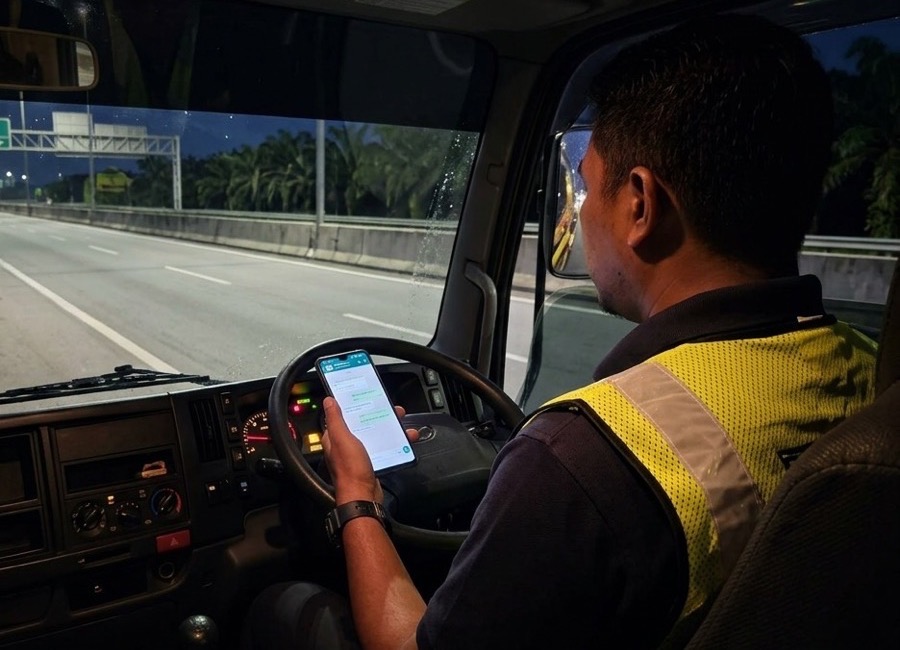
Stuck right now with no time to check policy terms? WhatsApp Abang Tow — send your live location, vehicle type and what went wrong. The full price goes into the chat first, then the unit moves. Standby 24 jam, across the Peninsula.
- Plus — the destination is yours. Trusted workshop, home, or temporary storage; say it once, delivered once.
- Plus — no distance cap, no quota. A run across state lines is arranged as one trip, not two.
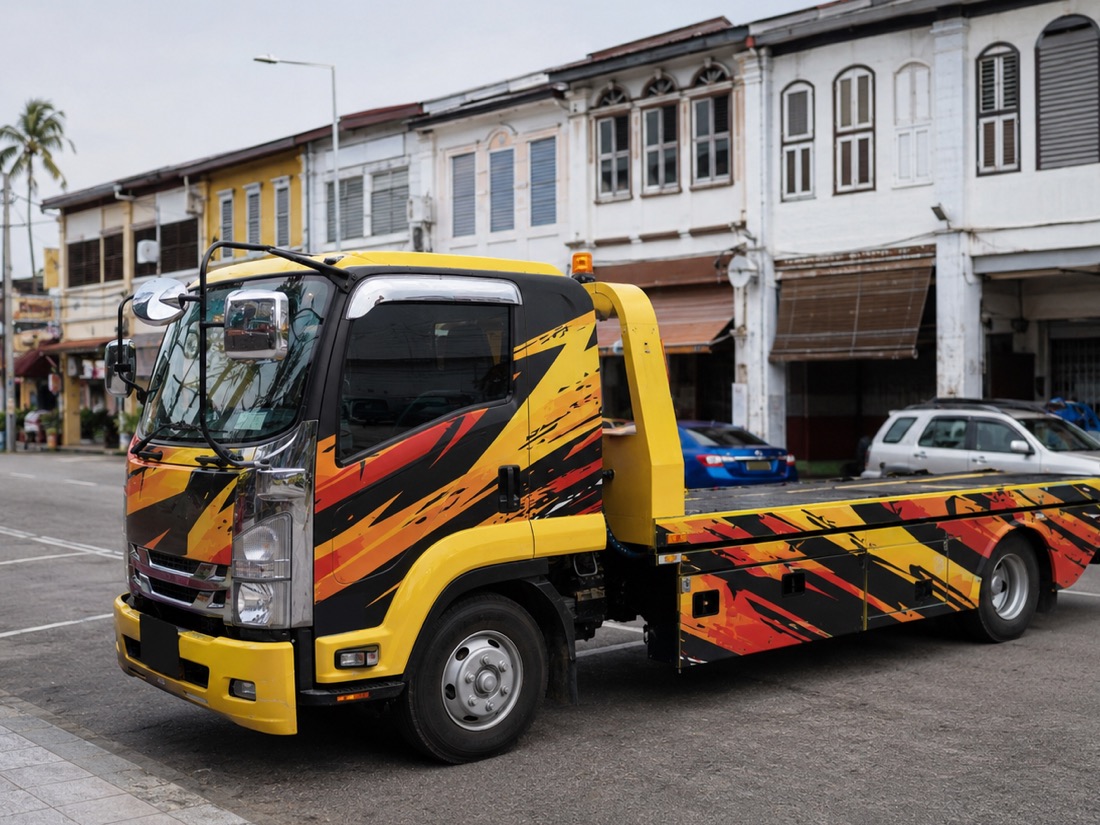
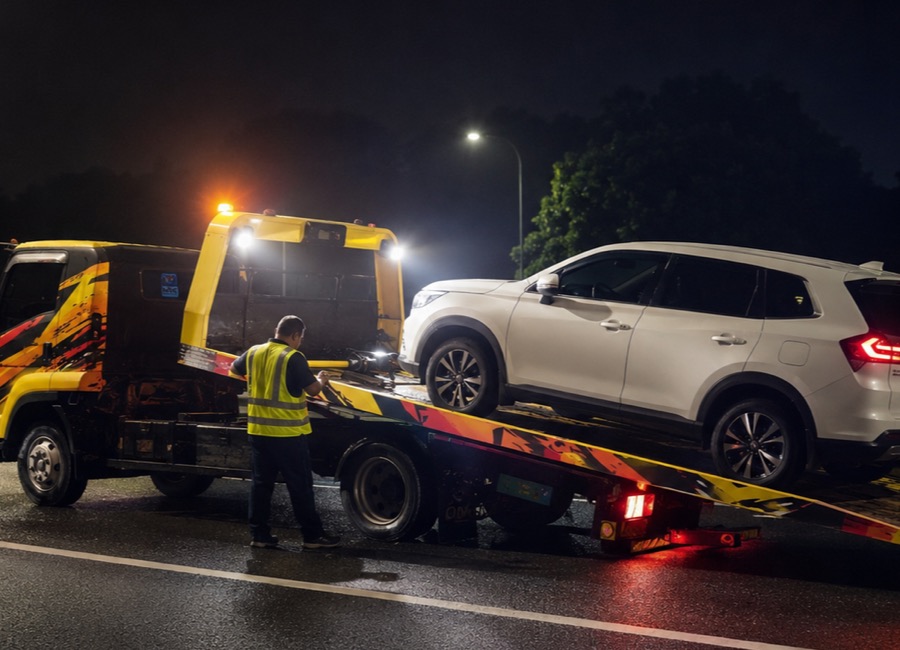
- Plus — you can request the right type of unit from the start: flatbed towing for EVs and autos that cannot be put into neutral, wheel-lift for tight city lanes.
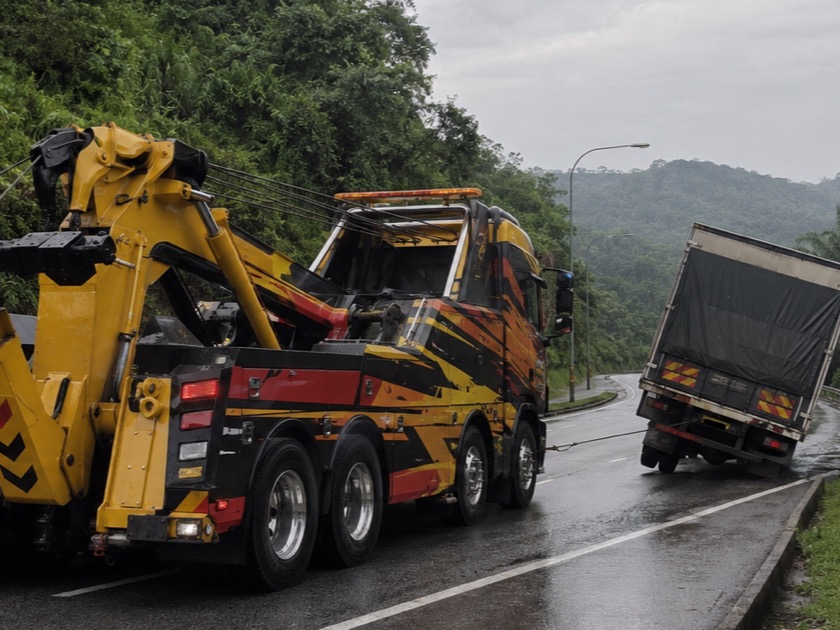
- Plus — cases the policy does not touch are accepted too: winching out of a drain, submerged cars, and heavy vehicles from 5-ton to 15-ton.
- Plus — the price is confirmed in writing over message before the unit moves, so there is no surprise at the destination.
- Minus — you pay out of pocket on the day itself.
- Minus — you need to know who to call. If the number was never saved, you will be scrolling Google while standing beside a highway.
- Minus — if you use a non-panel operator for a case that actually qualified, the benefit you already paid for cannot be applied to that job.
When The Policy Benefit Does Not Apply — Lorry Towing, Motorcycle Towing And Recovery Cases
This is the part that triggers the most roadside arguments at three in the morning. Not because anyone is lying — just because drivers never read the caps, and panel operators cannot bend the terms.
The four categories below get declined most often. If your case falls into any of them, do not waste time waiting on verification — arrange your own tow straight away.
- Commercial vehicles — lori, goods vans and heavy vehicles usually sit outside a private roadside assistance plan. A 5-ton, 10-ton or 15-ton lori needs a completely different unit, rigging and skill set from a car.
- Flooded cars — pulling a vehicle out of water counts as recovery work, not standard towing. Do not try to start the engine while you wait; that is what turns small damage into engine damage.
- Off-road incidents — monsoon drains, soft ground, construction sites or a slope beside the road. Winching needs powered steel cable and solid footing, so it counts as specialist work.
- Basic policies — third party or third party fire and theft normally carry no roadside assistance benefit at all. This benefit comes with comprehensive cover, or as a paid add-on you tick at renewal.
- Commonly declined extras: expired road tax, vehicles modified to the point of needing special equipment, and a call quota that is simply finished.
How To Combine Both — Benefit Up To The Cap, Then 24/7 Towing Service For The Rest
This is the least-used strategy even though it makes the most sense for long trips. The idea is simple: let the policy carry the first stretch of the journey, and you carry the remainder.
Picture the usual scenario — the car dies far from home, and the destination you actually want is well past the covered radius. The two bad options people usually take are accepting a panel workshop that is nowhere near convenient, or throwing away the benefit entirely and paying full price. There is a third way, and it only takes eight steps.
- Dial the roadside assistance hotline first, before you contact anyone else. The moment you use a non-panel operator, that job can no longer be claimed.
- Ask for two figures on that same call: how much distance is covered, and which panel workshop the car will be sent to.
- Get the real distance from where the car is to the destination you actually want. Subtract the policy cap from that figure — the remainder is the mileage you are paying for.
- Ask what the excess rate is per kilometre, and ask for the full ringgit total in writing over message, not spoken over the phone.
- At the same time, get one full quote from a private operator for the entire trip. Now you have two figures to compare.
- If the excess total lands close to the private full-trip quote, take the private one — because at roughly the same price you get the destination you want, in one trip, with no second transfer.
- If the excess is clearly cheaper, use the benefit and pay the excess portion yourself. Keep the receipt and the job reference number for your records.
- Photograph the vehicle from all four corners before it is lifted, whichever option you go with.
Verdict By Situation — From City Car Towing To Interstate Towing
There is no single right answer for everybody, but there is a right answer for every situation. Find the line closest to where you are right now.
- In town, short distance, private car, panel workshop is fine — use the policy benefit. It costs nothing at the scene; there is no reason to pay.
- Balik kampung, far from home, and you want it sent to your own workshop — combine both, or just book your own if the price gap is thin.
- Interstate towing across state lines — book your own. Policy caps are rarely enough for that kind of distance.
- EVs, autos that cannot be shifted into neutral, lowered cars, or a bike — book your own and ask for the right deck from the start: a flatbed for the car, proper straps for motorcycle towing.
- Lori or goods vans — book your own. State the tonnage upfront so the matching unit is sent in one go.
- Flood, drain or slope cases — book your own, and say clearly that it needs winching, not a straight lift.
- Third party policy, or quota already finished — book your own. Save one number in your phone before you need it.
- A car that keeps breaking down — save the benefit for the big cases and the long distances, and book your own for the small, nearby ones.
The Last Step To Take Before You Ever Need A Tow Truck
One thing you can do tonight, before anything happens: open your policy document, find the roadside assistance section, screenshot the pages showing the distance cap and the call quota, and save them to your phone gallery. A few quiet minutes now saves you a long, stressful scramble at the exact moment you can least afford it.
Then save one towing number right next to it. We cover 13 states across the Peninsula — if you spend most of your driving on the west coast, look at our Melaka towing coverage as an example of an area we run, or see our full 24/7 towing service across the Peninsula.
And if your car is already stranded right now: WhatsApp Abang Tow. Send the location, confirm the price, unit moves. Cars, motorcycles and lori — standby 24 jam, across Peninsular Malaysia.