Why Calling A Tow Truck Often Turns Into Two Or Three Calls
The car dies by the roadside. You call a tow truck. The operator asks ten questions, you answer with rough guesses, and the truck finally turns up — only to find it cannot lift your car.
Sounds like bad luck. It usually is not. Almost every towing job that drags on, gets the wrong unit sent, or ends in a price argument at the scene traces back to the same root cause: incomplete information on the first call.
An operator needs three things before he dispatches a unit — where, what, and in what condition. If any one of those is vague, he has to guess. Guess wrong and a wheel-lift shows up when your car needed a flatbed. Back to base, send another unit, time gone.
So calling a tow truck properly is not about saying the right words. It is about information. Read this checklist once now, screenshot it, keep it in your phone — because a breakdown almost always happens at the worst possible time.
The Quick Checklist Before You Call A 24 Hour Towing Service
Six things. If all of them land in one WhatsApp message, the operator can quote the price and send the right unit without going back and forth.
- Exact location — live location, a landmark, or the KM marker plus your direction of travel
- Vehicle — type, model, plate number, automatic or manual
- Condition — does the gear go into neutral? is the steering locked? do the wheels turn?
- Cause — battery, engine, accident, flood, or keys locked inside the car
- Destination — full name and address of the workshop, house, showroom or depot
- Access — basement, narrow lane, slope, soft ground, or highway shoulder
Exact Location: How To Send A Pin For Car Towing
"I am on the Federal Highway" is not a location. The Federal Highway runs for tens of kilometres, in two directions, with more than a dozen exits. A driver can pass right by you without noticing.
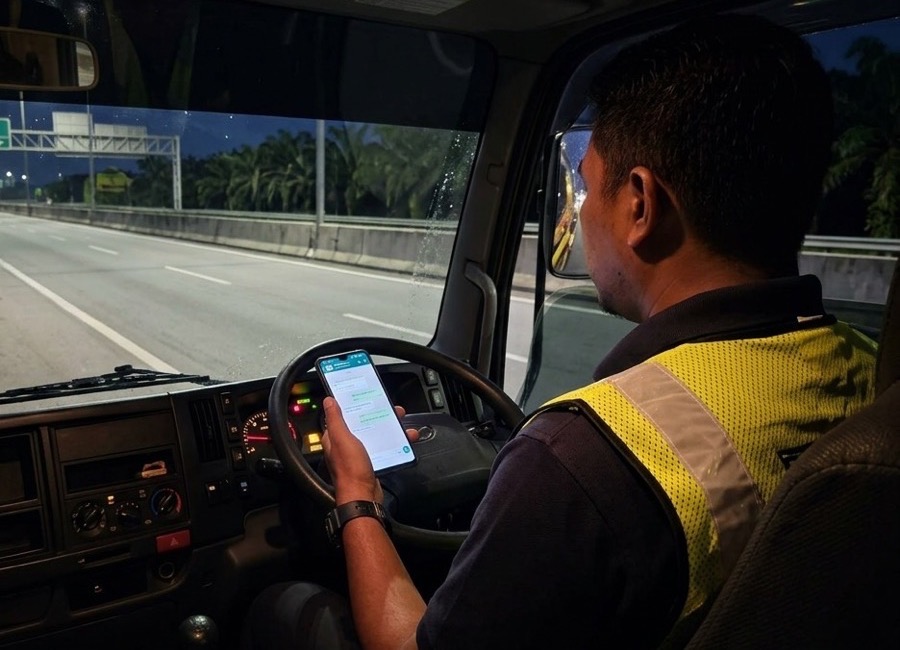
The most exact and fastest method: send live location on WhatsApp.
- Open the WhatsApp chat with the towing operator.
- Tap the paperclip icon (Android) or the + sign (iPhone).
- Choose Location, then Share live location.
- Set the duration to 1 hour and send.
- If the signal is weak, use Send your current location instead — it pushes the coordinates through even on slow data.
Landmarks And KM Markers For Roadside Assistance
Live location beats a static pin because if you have to move the car somewhere safer, the driver sees the change without having to ask again.
On a highway, add these three details. They are what separates a driver who finds you straight away from one who ends up circling:
- The KM marker on the shoulder (for example: KM 312.4) — the small post or board placed along the whole stretch.
- Your direction of travel — northbound or southbound, heading to KL or heading to Ipoh. Highways are divided; the wrong side means the driver has to loop back at the next exit.
- The last toll plaza or R&R you passed — the easiest thing to remember if you did not catch a KM marker in time.
Vehicle Details For Car Towing, Motorcycle Towing Or Lorry Towing
In town it flips the other way: landmarks beat addresses. "Basement B2, next to the Zone C lift" is far more useful than a street name. If you are somewhere you do not know yourself, open Google Maps, press and hold on the blue dot, copy the coordinates and paste them into the chat.
Location sorted, now the vehicle. The operator is not asking what you drive to make conversation — every answer decides which unit gets sent and what it costs.
- Type and model — Myvi, Hilux, Alphard, Hiace, a van, a kapcai, a superbike or a lori. The model sets the weight and the lifting method.
- Plate number — for confirmation at the scene, especially if you cannot stay and wait with the vehicle.
- Transmission — automatic or manual. Many automatics cannot be dragged with the wheels spinning without risking the gearbox.
- Drivetrain — 4WD or AWD. Most of them need all four wheels off the ground, which means a flatbed.
- EV or hybrid — say it early. An EV almost always needs a flatbed because the motors on the axle generate current when the wheels spin.
- Modifications — low coilovers, body kit or a bumper lip. A lowered car needs long ramps so the bumper does not get scraped.
- Height and width — matters for tall vans, a 4x4 with a roof rack, or any vehicle inside a multi-storey car park with a height limit.
Vehicle Condition: Wheel-Lift Or Flatbed Towing?
One more thing people forget: the keys. Do you have them or not? If the key is lost or locked inside the car, the lifting method changes completely — and the operator needs to know before he moves, not after he arrives.
Vehicle condition is the single biggest reason the wrong unit gets sent. You do not need technical terms. Just answer these four:
- Does the gear go into neutral? Try it with the brake pressed. If the engine is completely dead, most automatics have a small shift-lock slot near the gear lever.
- Does the steering turn? If the steering lock has engaged, the car cannot be steered onto the truck — it has to be pulled straight up.
- Do all four wheels turn freely? A flat tyre, a bent rim, a locked brake or a seized caliper all mean the wheels have to be lifted, not dragged.
- Is the electronic handbrake stuck on? Many newer cars lock the rear brakes when the battery goes completely flat. Mention it — it decides whether skids or dollies are needed.
Accidents And Floods: When Emergency Towing Is Handled Differently
After that, explain what happened in plain words. No diagnosis needed. "Engine cut out while I was driving, now it will not start at all" is already useful.
These three situations must be mentioned upfront, because they change the equipment, the method and the price:
- Accident — say whether the car is still on its wheels, has gone into a drain, or has rolled over. A car in a drain needs a winch, not just a lift.
- Flooded — do not try to start it. Say how high the water reached (floor, seats or dashboard). A flood-damaged car almost always goes on a flatbed.
- Smoking or on fire — move well away from the vehicle first, call the fire brigade, and only then sort out the towing.
Destination: Confirm The Workshop Before The Tow Truck Rolls
Towing is priced by distance. That makes the destination part of the price, not a minor detail. Change the destination halfway and the price changes with it — which is where most payment disputes begin.
Before you agree, lock down these four:
- The full name and address of the workshop — not "my usual place in Rawang".
- Whether the workshop is open. At 2 in the morning most are not — ask whether the vehicle can be parked out front or has to go in the next morning.
- Is there someone there to receive the vehicle and the keys? If not, confirm the key handover procedure in advance.
- If this is an insurance claim, confirm the workshop is accepted before the vehicle moves — not after.
Site Access And Interstate Towing — Basement, Lanes, Slopes
The destination does not have to be a workshop. Your house, a showroom, a lori depot or temporary storage all work. If the car broke down in Perak but home is in Johor, say upfront that this is an interstate job so the full distance is quoted in one go.
If you are stranded while reading this — do not wait until the end. Send live location, vehicle type and destination in one WhatsApp message to Abang Tow. The full price goes into the chat first, then the unit moves.
Now the part people forget most: access. Tow trucks are big, heavy, and cannot reverse the way a car can. Where your vehicle is sitting is sometimes a bigger problem than what is wrong with it.
- Underground car park — give the level (B1, B2, B3) and the height limit at the entrance. It is usually around two metres, so a flatbed cannot go in and the vehicle has to be dollied out first.
- Narrow lanes or housing areas with humps — a long truck may have to stop at the mouth of the lane.
- Slopes or soft ground — wet grass, a construction site, the edge of a paddy field. A winch and firm footing are needed.
- Guarded areas or barrier-gate car parks — tell the guard in advance, or ask the driver to call you when he reaches the gate.
- Highway shoulder — say whether the car is fully on the shoulder or still blocking a lane. A car blocking a lane is handled differently because it is a safety situation.
Questions You Should Ask The Tow Truck Operator First
While you wait: hazards on, warning triangle placed well back if you have one, and stand behind the guardrail — not inside the car, and not between the car and the traffic.
That checklist was the information you give. This is the information you should be asking for, before you say "ok, come".
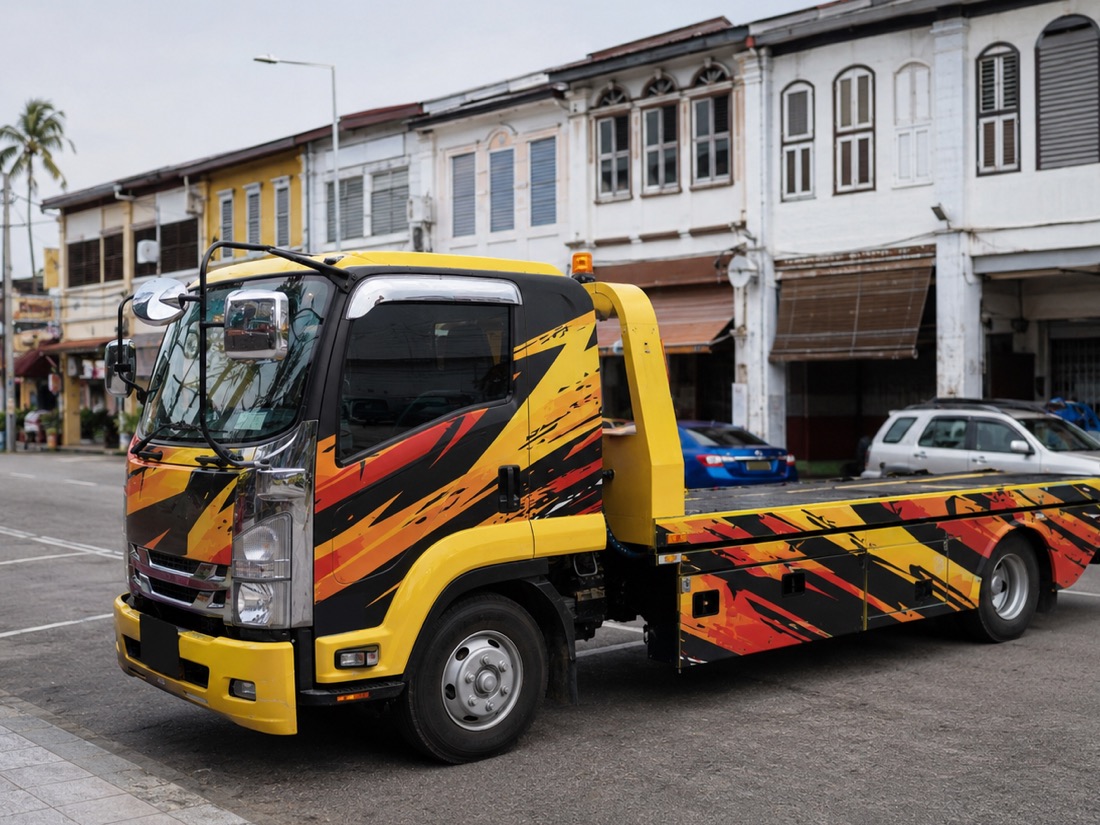
- Which unit is being sent — flatbed, wheel-lift or wrecker? If your car is automatic, lowered, 4WD or an EV, the answer should be a flatbed.
- What securing method is used? Ratchet straps over the tyres are safer for most modern cars than chains on the suspension.
- What is the full price and what does it include? Ask for the final figure as WhatsApp text — not "around two hundred plus la".
- Are there any extra charges? Ask directly about winching, basement access, waiting time and tolls. If they apply, they should be stated now, not at the workshop.
- What are the payment methods — cash, QR or transfer? Ask when too: before loading or after delivery.
- Can I ride along in the truck? If not, arrange your own transport before the vehicle leaves.
- The driver's phone number — so you can reach him directly instead of going through the main line.
Got Everything Ready? Contact 24 Hour Towing Now
Before the vehicle is loaded, take out the grant, insurance documents, toll card, dashcam and personal belongings. A car at the workshop is not a storage room. Photograph all four corners of the car and the odometer reading as well — two minutes now saves you a lot if there is ever a dispute.
Put it all into a single message like this and send it:
- Location: [live location] — highway southbound, KM 312.4, just past the last R&R
- Car: 2018 Myvi automatic, plate ABC 1234, all wheels turn, gear goes into N
- Problem: engine cut out while driving, will not start at all
- Destination: [full workshop name], Jalan Tampoi, Johor Bahru
- Access: car is on the shoulder, not blocking a lane