Police Report Done, Car Still Sitting There — Where Accident Car Towing Comes In
The frantic part is usually over by now. You have caught your breath, taken the photos, swapped details with the other driver, and been to the station to lodge the report. Malaysian road traffic law requires an accident to be reported within 24 hours, so most people deal with that part first.
Then the second problem shows up: the car is still there. Bumper hanging off, one wheel sitting at a strange angle, radiator dripping — and nobody can drive it home.
This is where accident car towing is a different job from an ordinary tow. A car with a flat battery just needs to be lifted and delivered. A car that has been hit may have wheels that will not turn, a bent chassis, fluid leaking, or it may be nose-down in a monsoon drain at the side of the road. The lifting itself becomes half the work.
This guide runs in the order things actually happen: safety first, then the type of unit the case needs, then the destination, and last the details we ask for so the correct unit is sent once — not twice.
Staying Safe at the Scene While the Tow Truck Is on the Way
Before you think about the car, think about the people. Most of the serious injuries that happen after a road accident happen to people standing around the vehicle, not in the original impact.
Traffic coming up behind you does not see you as early as you think it does — especially at night, in rain, or just past a bend.
Do these six things while you wait:
- Switch on the hazard lights the moment the car stops, even if the engine has died — most cars will still run the hazards.
- If the car can still move and the damage is light, get it onto the road shoulder or an open space. If it cannot move, do not force it.
- Put the warning triangle far back behind the vehicle — the faster the road, the further back it goes. On a highway, far means far, not two steps.
- Get out through the left-hand doors if you are on the shoulder, then stand behind the barrier or up on the grass verge. Do not sit inside the car, and never stand between the car and the traffic.
- If you smell petrol, see smoke, or see burnt wiring, move well clear and call Bomba first. Towing comes after that, not before.
- Take another round of photos once everybody is safe: all four corners of the car, close-ups of the damage, where the car is sitting on the road, and the odometer reading. These help with the claim later.
Why an Accident Car Needs Flatbed Towing and Winching, Not a Rope Pull
The question that lands in the chat most often: "Cannot just pull it with a rope, ah?" For an accident car, the answer is almost always no.
Pulling with a rope or a tow bar means the damaged car is still rolling on its own four tyres, and somebody still has to sit inside to steer and work the brakes. A car that has just taken a hit has usually lost both of those — brake boost disappears when the engine dies, the steering goes heavy, and nobody should be sitting in a vehicle whose chassis has not been checked.
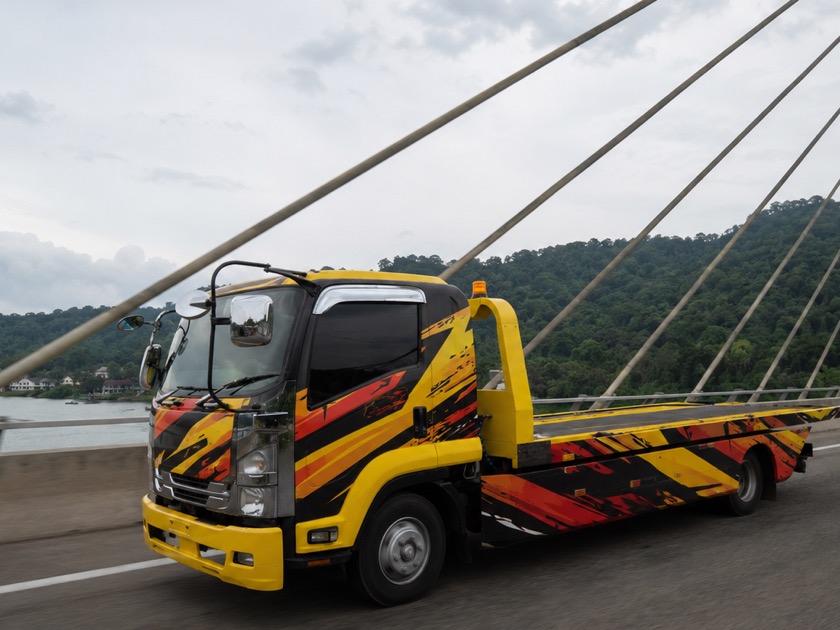
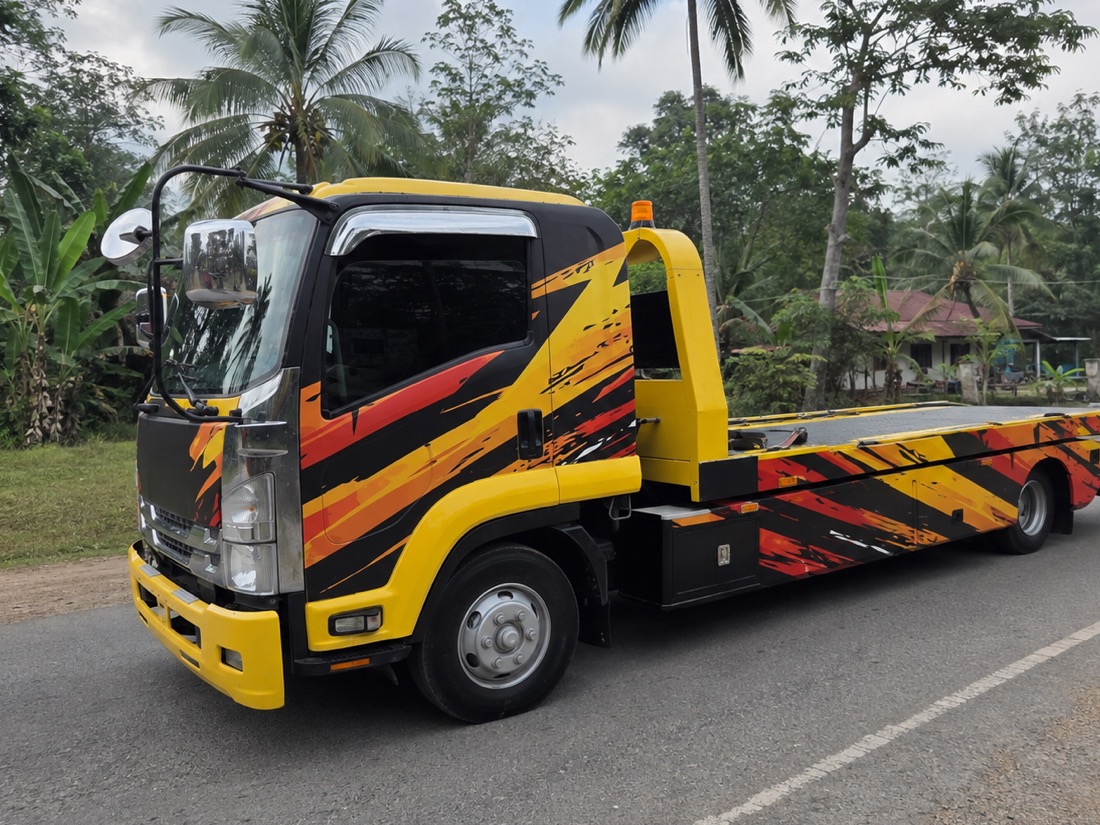
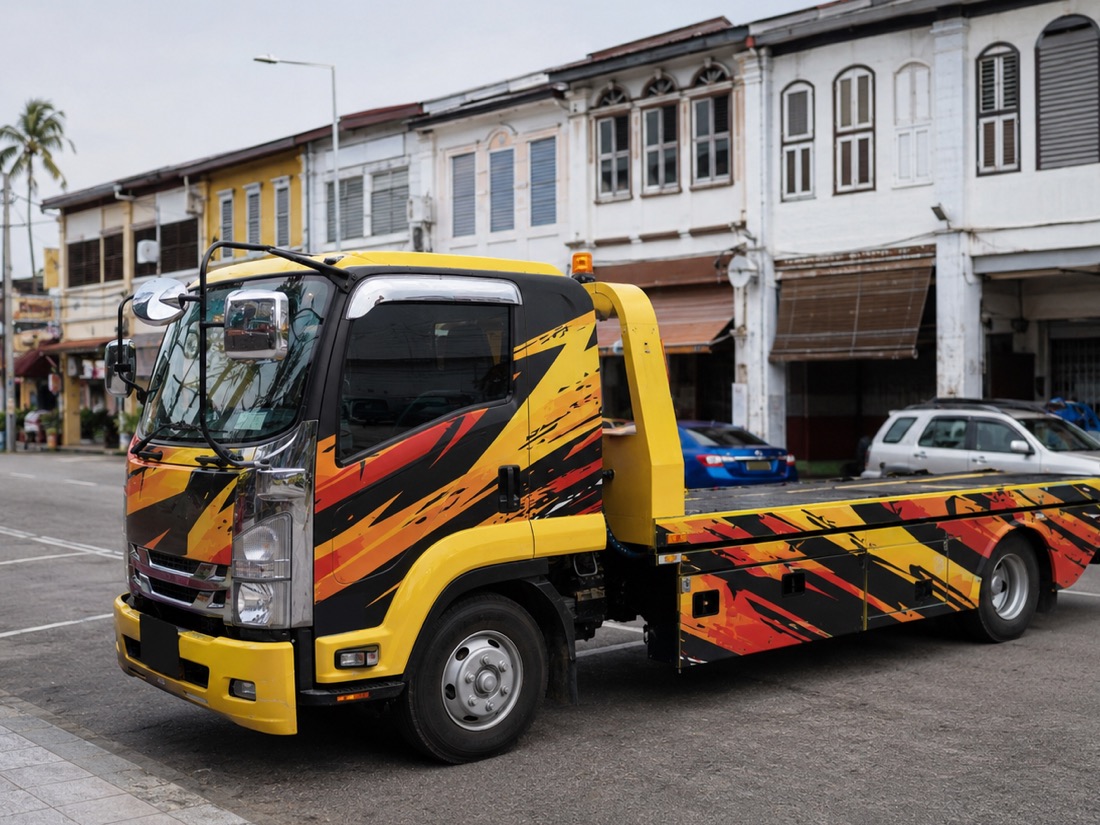
Flatbed towing solves this because the whole car goes up onto the platform. No wheels turning, no load on suspension that may already be bent, and no debris scattering down the road behind you. That is why accident cases, flood-damaged cars, low-slung cars and EVs all fall into the same bracket — every one of them is safer on a flatbed.
Winching is the work that happens before the car goes up on the platform. It uses a powered steel cable to drag the vehicle from wherever it is stuck to a spot where it can be lifted. Four situations normally call for a winch:
- The car has skidded into a drain, a monsoon drain, or down the slope at the side of the road.
- The car is bogged down in soft ground, wet grass, or a construction site after running off the tarmac.
- The car has spun and is facing the wrong way in a tight space — it has to be repositioned before it can go up the ramp.
- The car is on its roof or leaning against a guardrail; it has to be set upright before any lifting starts.
Gear Stuck in P or Wheels Locked: How a Towing Service Handles It
This is the part that causes the most wrong units being sent out. After an accident, two things often happen at the same time: the gear jams in P, and one or two wheels will not turn at all.
The gear jams because most autos lock the shifter when there is no electrical power. Locked wheels can come from a bent rim, a seized brake caliper, an electronic handbrake that latched when the battery was cut, or a suspension arm that is no longer straight.
You do not need to fix any of it. You only need to know the condition and tell us early. Run through these five checks before you send the message:
- Try neutral — press the brake, put the start button to ACC if you can, and move the lever to N. If it will not budge at all, stop. Do not force it.
- Test the steering — turn it a little left and right. If it is locked solid, say "steering lock".
- Check every wheel — rock the car slightly if it is safe, or just look for a flat tyre, a bent rim, or a tyre jammed against the fender.
- Look under the car from a safe distance — anything dripping? What colour? Black means engine oil, green or pink means coolant, and clear and oily means brake fluid.
- Write all of that into one message. Four words is enough: "gear stuck P, front left wheel locked".
Panel Workshop, Own Workshop or Home — Deciding Your Car Towing Destination
Even with the gear jammed and a wheel locked, the car can still be lifted — the method just changes. The operator will use skids or dollies under the wheels that will not turn, or winch the car straight up onto the flatbed so no wheel has to roll at all. What matters is planning it ahead, because that equipment has to already be on the truck before it leaves.
If your car is sitting by the road right now, do not wait until you finish reading. WhatsApp your location, plate number and wheel condition to Abang Tow — the full price is confirmed in the chat first, then the unit moves.
Now the part people tend to decide in a rush: where the car is going. Distance is what sets the price, so changing the destination halfway through changes the price too. Think once, decide once.
- Panel workshop — the workshop accepted under your policy for claim work. Confirm which one is accepted before the vehicle moves, not after it arrives. Check that it is open and that somebody is there to take the key.
- Your own workshop — usually the choice for pay-yourself repairs, or when you simply trust one particular mechanic. Give the full name and address, not "my usual workshop in Rawang". If it closes at night, ask whether the car can be left outside the gate or has to wait until morning.
- Home or temporary storage — a sensible option if you have not settled on a workshop yet, or you are waiting on an inspection. Make sure there is room for the truck to get in and turn around; housing areas with humps and narrow back lanes need to be mentioned upfront.
What We Ask Before Sending a Unit: Car, Motorcycle Towing or Lorry Towing
One complete message saves a lot of back-and-forth, and more importantly it lets the price be worked out and confirmed before the truck moves. Car towing starts from RM250 for a move under 50 km, from RM450 under 100 km, and from RM550 under 150 km, depending on distance, vehicle type and wheel condition.
The same details apply whatever got hit. Motorcycle towing means the bike travels strapped down on a dedicated moto lori, not balanced behind somebody’s car. Lorry towing is matched to tonnage instead — 5 tonne, 10 tonne or 15 tonne — so the vehicle type and weight need to be in that first message.
Copy this format, fill in the blanks, send:
- Location — WhatsApp live location. On a highway, add the KM marker and the direction you were heading (example: northbound, past the last toll plaza).
- Vehicle — car model, auto or manual, and the plate number. For a bike, the model and engine size; for a lori, the tonnage and whether it is loaded.
- Wheel condition — all turning freely, or which ones are locked or flat.
- Where the vehicle is sitting — on the road, on the shoulder, in a drain, on a slope, or blocking a traffic lane.
- Damage — which side took the hit, anything leaking, glass broken, or debris scattered around.
- Destination — the full name and address of the workshop, or the home address.
- Claim case or paying yourself — so we know whether the receipt and delivery details need to be arranged for your paperwork.
Recap: Roadside Assistance, Interstate Towing and the Right Order to Act
If you only remember one thing: people first, police report second, car third. Cars can be repaired or replaced. People cannot.
An accident case is not a roadside assistance job either — nobody is jump-starting a car with a bent chassis by the side of the road. It needs a lift, and the sooner the better. A vehicle left on a highway shoulder risks being hit a second time, and scattered debris is a hazard for every driver coming through.
WhatsApp Abang Tow with those seven details. We confirm the unit and the full price in the chat, then the unit moves — standby 24 hours, across the whole Peninsula, including interstate runs if the car needs to go back to your home state.