Stranded on the Emergency Lane — What Really Happens Before Car Towing Arrives
The car loses power, you manage to drift left, and now you are sitting on the emergency lane with lorries and cars overtaking at full speed a hand span to your right. The body rocks every time a trailer goes past. That is not your nerves — that is genuine air pressure off heavy vehicles.
This is where most drivers make the wrong call. Not because they are careless, but because they are rattled and have never been in this position before. Some step out of the right-hand door straight into the fast lane. Some stand in front of the bonnet with the hood up. Some start walking along the shoulder looking for a toll plaza.
Hold on to one fact: a car stopped on a highway shoulder is the single highest-risk target for a rear-end hit, and the most dangerous place at that moment is inside and around that car. Engine damage can be repaired. The other thing cannot.
So the order of priority is simple: people first, location second, car third. Read the rest of this in that order.
Safety Steps While You Wait for Roadside Assistance
While the car is still rolling, aim for a straight, open stopping point. Avoid stopping just after a bend, on a bridge, inside a tunnel, or at the mouth of an on-ramp or exit — in those spots the driver behind only sees you at the last second. If a lay-by, an R&R or an exit is within reach of your momentum, keep going to it. Far safer than stopping early beside a fast lane.
Once stopped, get the car as far left as it will go. If there is gravel or grass, let the left wheels ride up onto it. Every extra metre between your body panels and the traffic lane is a metre of safety margin.
Then get everybody out. This is the part people most often get wrong — plenty choose to sit inside with the air-con running while roadside assistance is on the way. Do not. Get up behind the guardrail or onto the slope, and stand well behind the car, not in front of the bumper.
- Hazards on immediately. At night or in rain, switch the side lights on too — a dark car on the shoulder is almost invisible.
- Handbrake up, gear in P (auto) or first gear (manual), wheels turned slightly left so the car is pushed away from traffic if it is hit.
- Everybody out through the left-hand doors only. Children and elderly passengers move first.
- Stand behind the guardrail, facing oncoming traffic so you can see what is coming.
- Warning triangle roughly 50 metres back — further if you stopped after a bend or over a crest. If the shoulder is narrow or the rain is heavy, skip it; the hazards are enough.
- Do not change a tyre if the damaged one is on the right-hand side. You would be working with your back to the fast lane.
- Do not walk along the shoulder looking for help. Stay in one place and let the unit come and find you.
- Take your phone, power bank, water, keys and vehicle documents out with you before you retreat behind the barrier.
How We Pin Down Your Location to Send the Nearest Tow Truck
A highway has no house numbers. That is why location on a highway has to be sent differently from a breakdown in town, and it is the single biggest cause of delay when it is sent wrong.
The most accurate way: WhatsApp live location. It gives real coordinates, not an estimate. If data is weak or the battery is critical, three other details work just as well.
First, the kilometre marker. Those small white posts at the roadside carry a KM number — that is your official address right now. If you can see one, snap a photo and send it.
Second, your direction of travel. This is the detail most often left out, and it matters because the two carriageways are separated by a divider. KM 210 northbound and KM 210 southbound are two different locations, and a unit cannot simply cross between them. Say where you were heading: for example, "northbound, KL to Ipoh".
Third, the last toll plaza or R&R you passed. That is the rough confirmation that tells us which stretch you are on and which entry point is closest for a unit.
Send those three things in one message and we can match a unit from the correct side of the highway straight away. WhatsApp us now with those three details — we reply with the full price before the unit moves, and no charge appears afterwards.
- WhatsApp live location (most accurate) — or the nearest KM marker number.
- Direction of travel: northbound or southbound, and from which town to which town.
- The last toll plaza or R&R you passed.
- Vehicle type: model, auto or manual transmission, EV or combustion engine.
- The problem: engine cut out, overheating, blown tyre, or an accident.
- How many people are in the car — so we know your situation at the roadside.
- The final destination you want: workshop, home, or another state.
Tow Truck Access to the Emergency Lane and the Onward Run From the Toll Plaza
This is the part most people do not know, and it changes how you should make the call.
While you are between the entry and exit toll plazas, that stretch is under the highway concessionaire’s control. Their appointed recovery operators have priority to work inside it. Private tow trucks generally are not allowed to move freely within the tolled section. So your first call has to be the concessionaire’s assistance line — the number is on the roadside signboards, on the back of the toll ticket, and in the official concession app.
Their unit comes out and does a basic check first. If the vehicle genuinely cannot move, their recovery unit tows you out of the highway area to a designated point — usually a toll plaza, a lay-by outside the toll, or their own holding spot. That is the full extent of their scope.
And that is where the second problem starts. Your car is now parked beside a toll plaza at maybe 2 in the morning, in a spot it cannot be left in for long, with a workshop still 40 km away and not yet open.
Our work starts from that point. A private towing service takes over the second half of the journey: from the toll plaza to the destination you choose. The efficient way to do it is to WhatsApp us in parallel while you wait for the concession unit — not after the car reaches the plaza. Do it in parallel and the onward run is already lined up, so you are not stranded a second time somewhere even less comfortable.
After the Toll: Nearby Workshop or Car Towing Back to Your Home City
A highway breakdown usually happens far from home. A car that dies on the Tapah–Bidor stretch on a Kuala Lumpur to Penang run leaves you with two real options, and this decision is best made early — while you are still waiting behind the guardrail, not after the car is parked beside the plaza.
Option one: send it to a nearby workshop. Sensible if the fault looks minor, you need to continue your journey quickly, or the car cannot be left for long. The downside is that you hand the car to a workshop you do not know and cannot easily keep an eye on.
Option two: bring it back to your home city, to your usual workshop or straight home. Longer distance and higher cost, but the car ends up with a mechanic you trust and you can deal with it in the morning with a clear head. For a big failure like a gearbox or engine, that is often better value than paying twice for the same job.
Car towing is priced by distance from pickup to destination: from RM250 for a move under 50 km, from RM450 under 100 km, and from RM550 under 150 km. Those are starting prices — the final quote lands on WhatsApp before the unit moves, and the price you agree to is the price you pay.
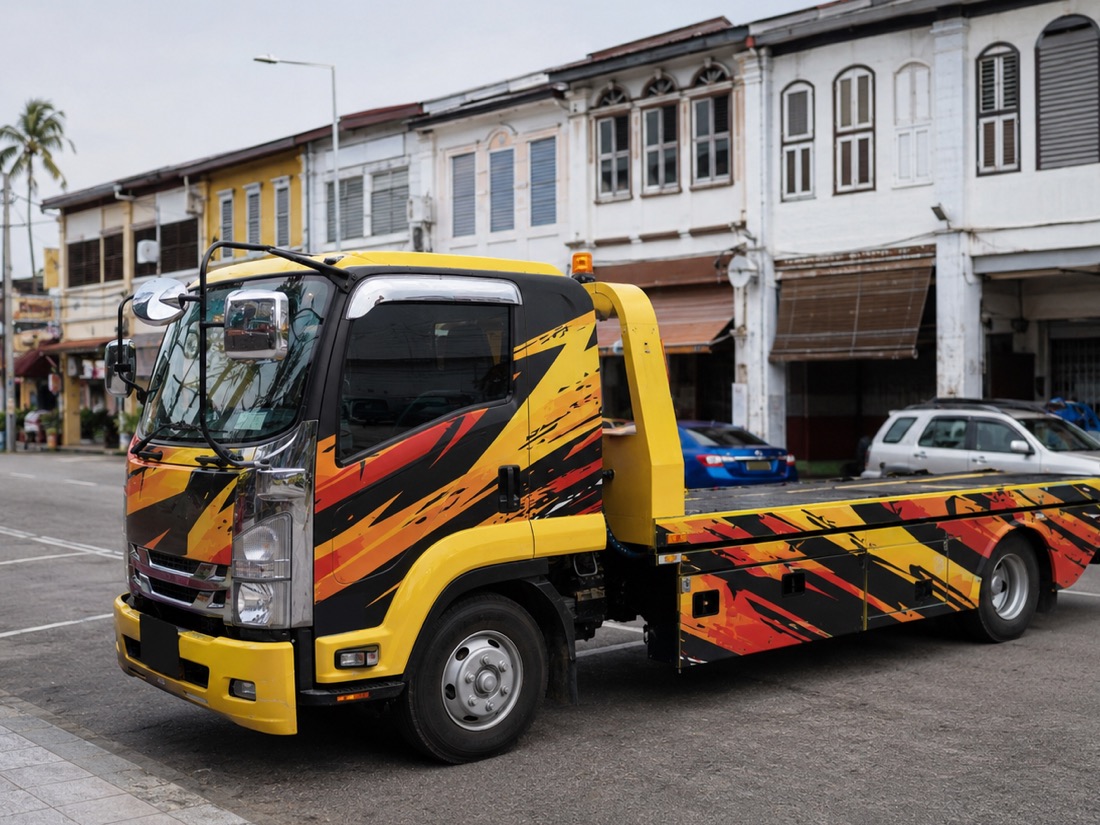
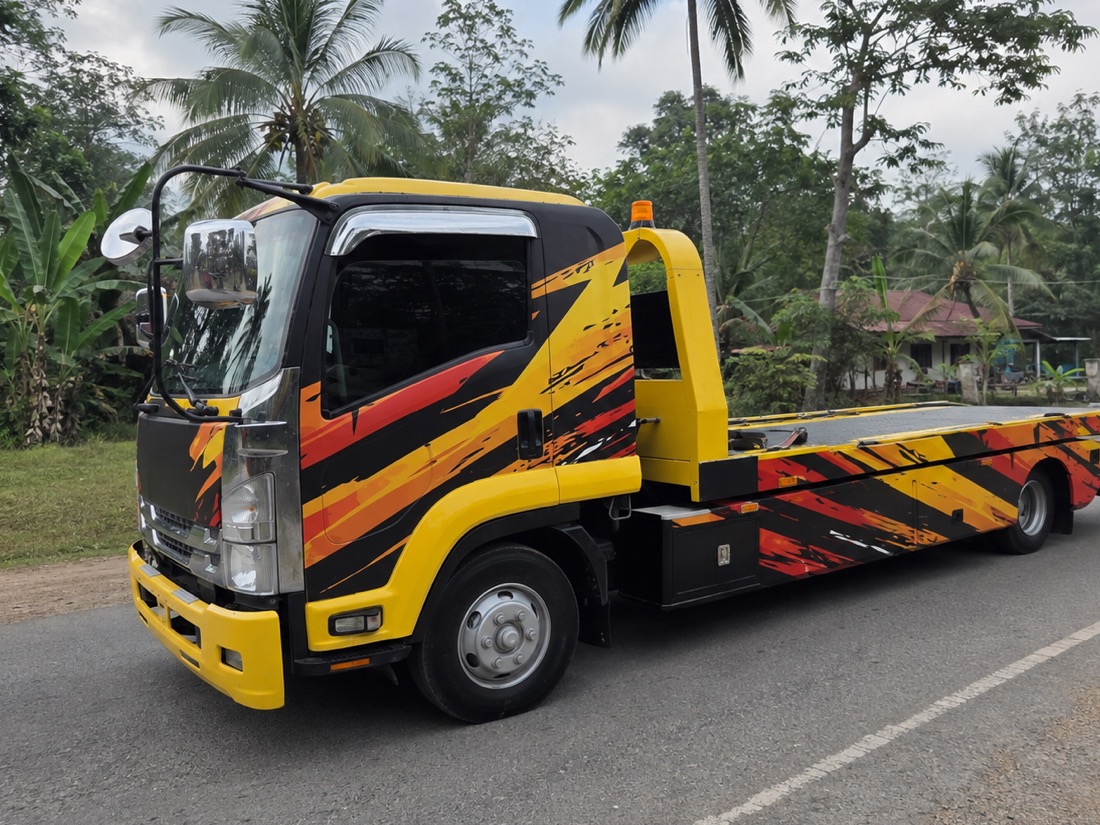
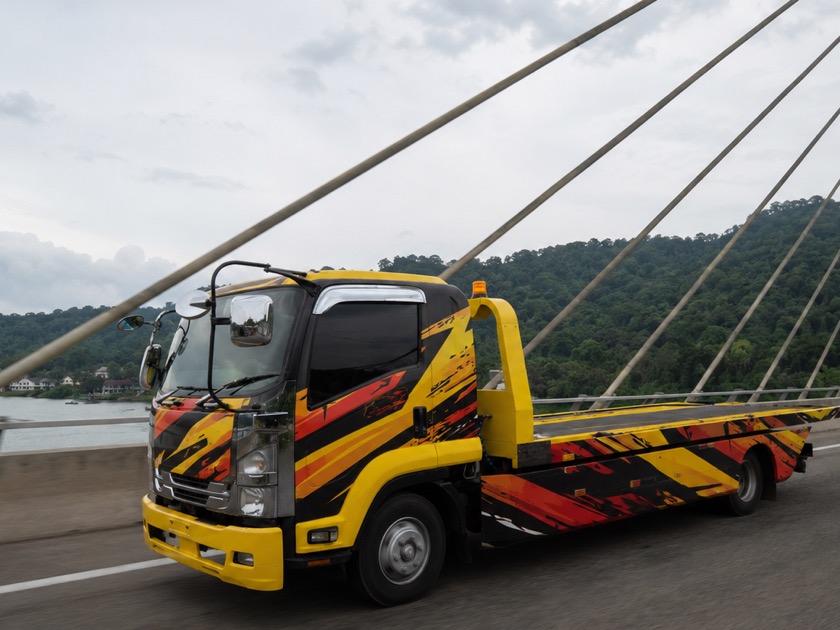
One technical detail worth saying early: vehicle type. EVs and automatics that cannot be released into neutral need to be carried fully on a flatbed so no driven wheel is turning along the way. Tell us the model and transmission on WhatsApp and the correct unit is dispatched, with no time wasted swapping units at the toll plaza.
If the breakdown involved a collision, photograph the vehicle’s position before it is moved. That is the basic requirement for the report and any claim later on.
Heavy Vehicles on the Highway — Lorry Towing at 5, 10 and 15 Tonne
If the vehicle that stopped is a lori or a bus, everything above still applies — the scale is just different, and the risk is higher.
A heavy vehicle stopped on the shoulder blocks more space, is harder to see if it stopped after a bend, and cannot be pulled with an ordinary car unit. The unit class has to match the tonnage, or the coupling can damage the chassis or fail outright mid-run.
That is why the first thing we ask for on a heavy vehicle case is not the location but the tonnage and the body type. Box lorry, tipper, prime mover with trailer, or bus — each one has different rigging methods and hook points. The load matters too: a fully laden lorry may need to be unloaded before it can be pulled safely.
Lorry towing is priced by tonnage rather than distance alone: from RM450 for a 5 tonne lorry, from RM550 for 10 tonne, and from RM850 for 15 tonne. Same as cars — starting prices, with the full quote confirmed on WhatsApp before the unit moves.
For commercial vehicles there is one more layer a private driver never has to think about: downtime is cost. Say upfront if the load has to be transferred to another vehicle, or if the lorry has to go across state lines back to your depot. Interstate work is a core service for us, and it is cheaper arranged in one run than as two separate tows.
Broken Down Right Now? 24/7 Towing on Standby Along the Highway
If you are reading this standing behind a guardrail with your hazards on — good, you have already done the part that matters most. Now open WhatsApp.
Send three things only: live location or the KM marker number plus your direction of travel, the vehicle type and the problem, and the final destination you want. We reply with the full price, you agree, the unit moves.
Abang Tow is on standby 24 hours, seven days a week, across all 13 Peninsular states — including the middle of the night, weekends and public holidays. Car, bike, lori or bus, one number.
And if you are reading this calmly at home: save the number now and forward it to the family before any long drive. If you are the one who breaks down, they can handle the call while you concentrate on staying safe at the roadside.